

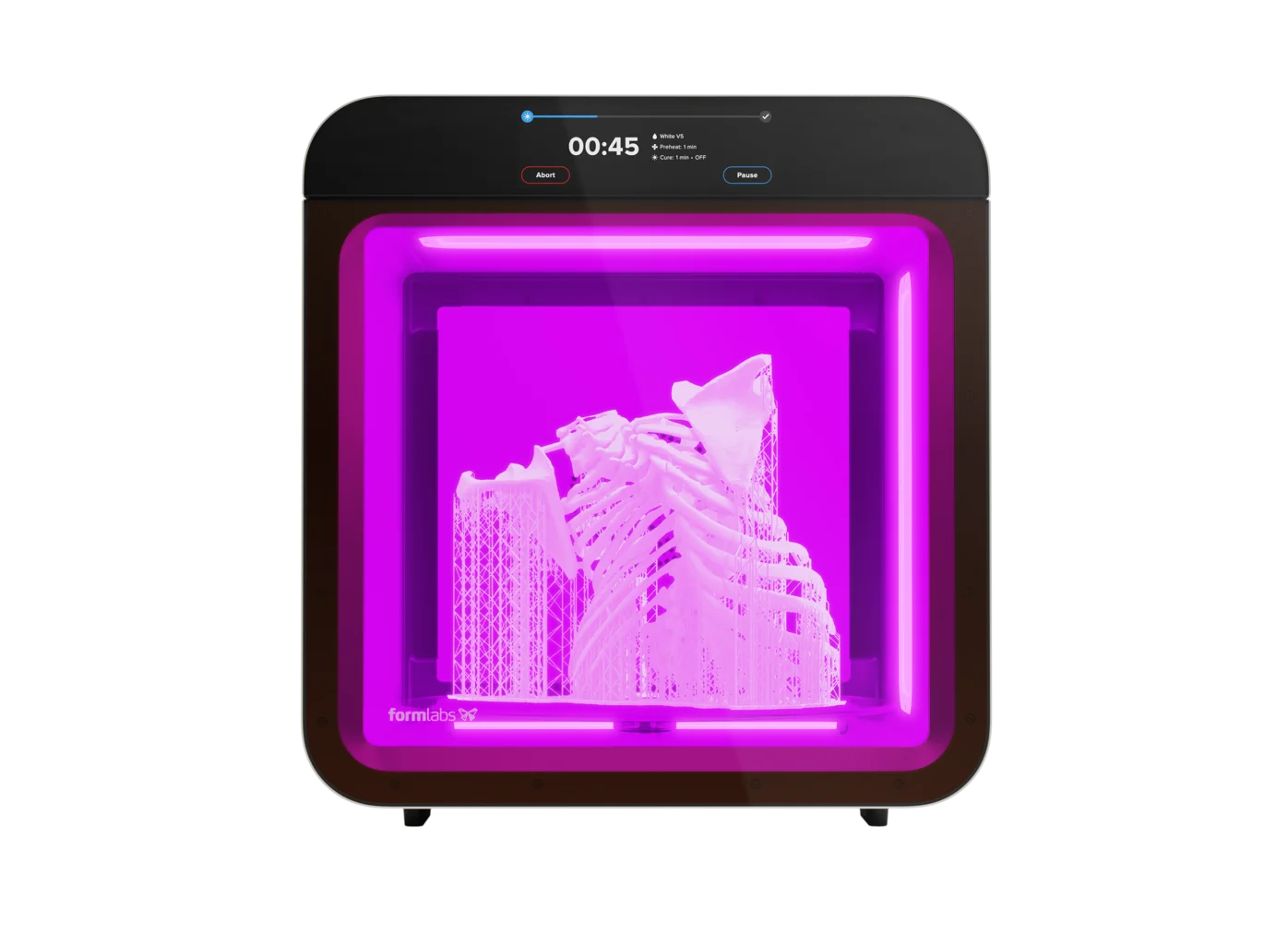
Why Post-Curing Matters: Maximize Part Performance
Post-curing is an essential final step that fundamentally improves your 3D-printed parts on a molecular level. Utilizing 405 nm light, this process initiates a chemical reaction that cross-links the individual polymers.
This reaction transforms the material into an interconnected, isotropic (uniform in all directions), and 100% dense final part, delivering significant upgrades in performance.
Enhanced Material Properties
By completing the cross-linking reaction, post-curing drastically improves the mechanical and thermal characteristics of your printed resin:

Rapid Heat Up
Two 700 W heaters quickly heat the chamber up to 60℃ in just 60 seconds.
Uniform Light
96x multi-directional LEDs ensure consistent irradiance across the entire build volume.
Fast Cycles
General purpose resins cure in as little as 60 seconds, while engineering resins finish in under 15 minutes.
Smart Automation
Select from a library of 45+ validated material presets for instant, optimized curing.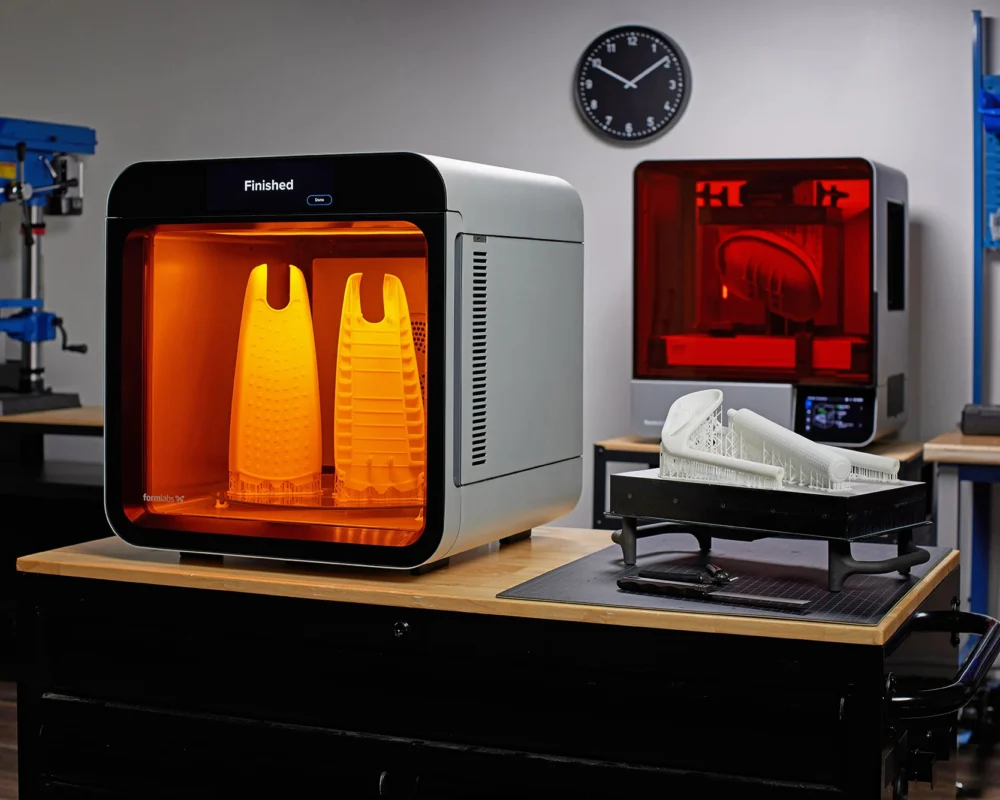
Can The Form Cure L V2 Nitrogen Cure?
During post-curing, oxygen molecules can interact with free radicals in the resin to prevent them
from forming bonds and curing. This phenomenon is called oxygen inhibition, and can cause
surface tackiness, and poorly cured parts. By displacing the oxygen within the Form Cure with
nitrogen, users can ensure parts are fully cured. Certain resins, like elastomeric materials, are
more susceptible to inhibition, which is why we recommend some of those materials to be cured
while submerged in water (which also displaces oxygen). Nitrogen curing is not a required
workflow for any Formlabs resin, but we want to leave the option open to users who want to try it.
It is recommended to cure in water/glycerin/oil to achieve the same results as a nitrogen cure.
Technical Specification
Formlabs Form Cure L V2 Tech Specs
| Installation surface | Benchtop unit |
| Minimum dimensions for convenient access (W x D x H) | 60.0 x 110.0 x 56.0cm 23.6 x 43.3 x 22.0in |
| Product dimensions (W x D x H) | 50.7 x 54.3 x 54.5cm 20.0 x 21.4 x 21.5in |
| Product weight | 43.0 kg 94.8 lb |
| Shipping weight | 247 microns 0.0097 in |
| Turntable diameter | 40.4 cm 15.9 in |
| Curing volume (W x D x H) | 42.3 x 42.3 x 36.5 cm 16.7 x 16.7 x 14.4 in |
| Maximum part height | 365 mm |
| Maximum part dimensions (W x D x H) | 35.3 x 19.6 x36.5 cm 13.9 x 7.71 x 14.4 in |
| Operating environment | 18–28 .C 64–82 .F |
| Power requirements | Input (NA): 100–125 VAC, 50–60Hz, 15 A Input (EU): 220–240 VAC, 50–60Hz, 8 A |
| Maximum post-cure temperature | 100 .C 212 .F |
| Light source | 96 multi-directional LEDs |
| LED electrical power | 350w |
| LED radiant power (total) | 120w |
| LED wavelength tolerance | 400–410nm |
| USB connectivity | USB (rev 2.0) B port with a USB-C cable |
| Sound emission | Does not exceed 55 dB(A). |
Have Questions About The Form Cure L V2?
7A Kent Street,
Yarraville, VIC 3013, Australia
Monday to Friday
9:00 am to 5:00 pm (AEST)
Get Intouch
Contact one of our 3D printing experts for more information on this product or to request a quote.
Related Products

Formlabs Form 4BL
The Formlabs Form 4BL is a high-performance printer 3D Printer designed for medical & dental applications, offering exceptional speed and accuracy.

Formlabs Form 4
Formlabs Form 4 3D printer delivers industrial-grade quality products in-house, within hours. Using a variety of high-performance materials.

Formlabs Form 4B
Formlabs Form 4B represents the next evolution in dental and medical stereolithography (SLA) 3D printing technology.

Formlabs Form 4L
Formlabs Form 4L is a blazing fast masked SLA 3D printer with industry-leading materials library and a reliable, accurate print engine.

Industry-Leading Expertise
With years of experience and a team of skilled professionals, Freedspace delivers unparalleled knowledge in 3D printing, scanning, and design.
Comprehensive support
We offer comprehensive support for the products we sell, ensuring you get the most out of your 3D tools and technologies.
Personalised Ongoing Support
From setup to advanced troubleshooting, our support team is here to ensure your technology keeps delivering value.