


Bridge the Production Gap in 48 Hours
Skip the $20,000 mold costs and 8-week lead times. Deploy industrial additive solutions that deliver production-grade accuracy in hours, not months.
Additive Manufacturing
3D printing is more than just rapid prototyping. Additive manufacturing for the production of end-use parts is revolutionising manufacturing by delivering on-demand production of parts without the restrictions of traditional manufacturing techniques and the ability to adapt to design changes quickly.
For the right applications, additive manufacturing can deliver a perfect combination of complex geometries, improved performance and streamlined production. This dramatically reduces the cost and speed of production, especially when producing low production numbers, as a replacement for bridge tooling or when integrating multiple parts of an assembly into a single component.
Unlike traditional manufacturing processes, which work by using subtractive techniques to machine parts directly or to create of moulds, additive manufacturing uses 3D digital models from CAD data to build a part by adding material layer by layer. The additive process means less wastage and fewer restrictions in the type of geometries that can be constructed when using a cutting tool to remove material from stock.
If you would like to know more about how to use additive manufacturing to produce end-use parts, contact us and speak to one of our experts.
Production with Additive Manufacturing
At Thinglab, we provide the engineering industry with a comprehensive suite of advanced manufacturing services. From initial concept and reverse engineering to the delivery of high-performance end-use parts, we empower engineers to move faster and design without the constraints of traditional tooling.
Breaking the “Tooling Trap”
For decades, injection molding has been the industry standard for high-volume production. However, it comes with a significant “barrier to entry” that often stifles innovation:
- Prohibitive Costs: Traditional molds typically require an upfront investment of $10,000 to $100,000+.
- Stagnant Lead Times: Waiting 60+ days for a tool to be cut delays your speed-to-market.
- Design Rigidity: Once the steel is cut, you are “locked in.” Even minor design revisions can result in thousands of dollars in rework and weeks of downtime.
Selecting the Right Platform
Different production goals require different methods. Thinglab helps you navigate these core industrial technologies.
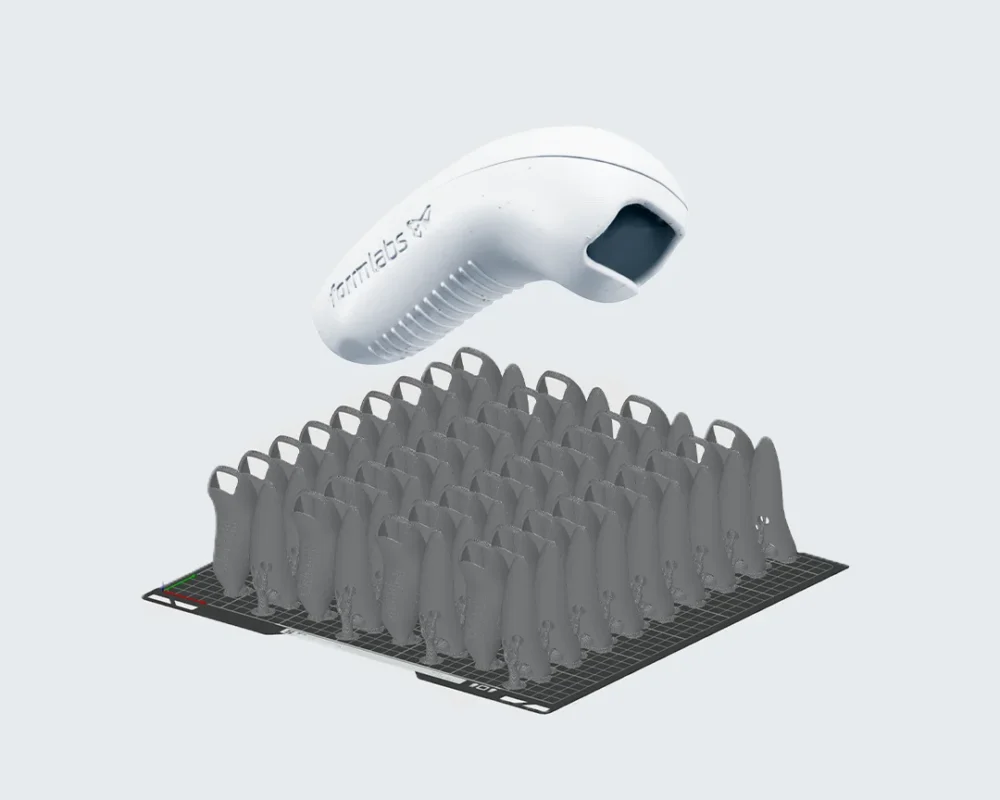
Filament (FDM)
Manufacturing aids, heavy-duty jigs, large-scale prototypes, and tooling components where structural toughness is the priority over cosmetics.
Output: 260 parts per week
Durability: Medium (weak in one axis)
Surface finish: Medium
Post-processing: Manual support removal
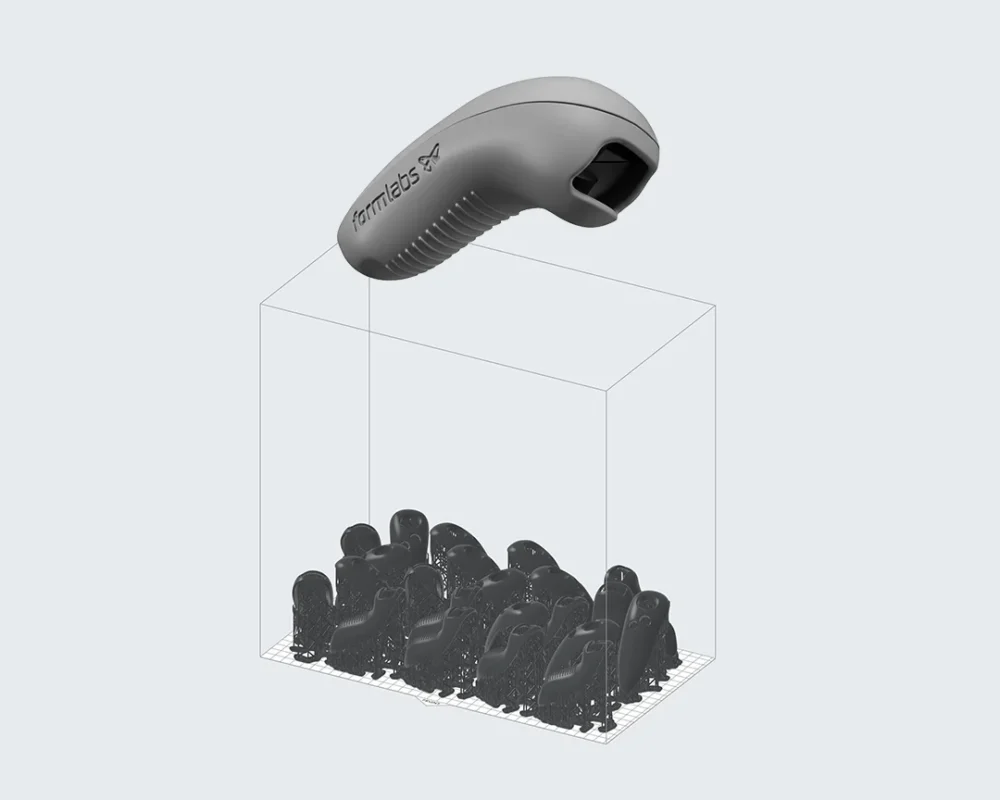
Resin (SLA)
End-user electronics housings, high-detail connectors, clear lenses, and components requiring water-tight or airtight properties.
Output: 600 parts per week
Durability: High
Surface finish: Very High
Post-processing: Manual support removal
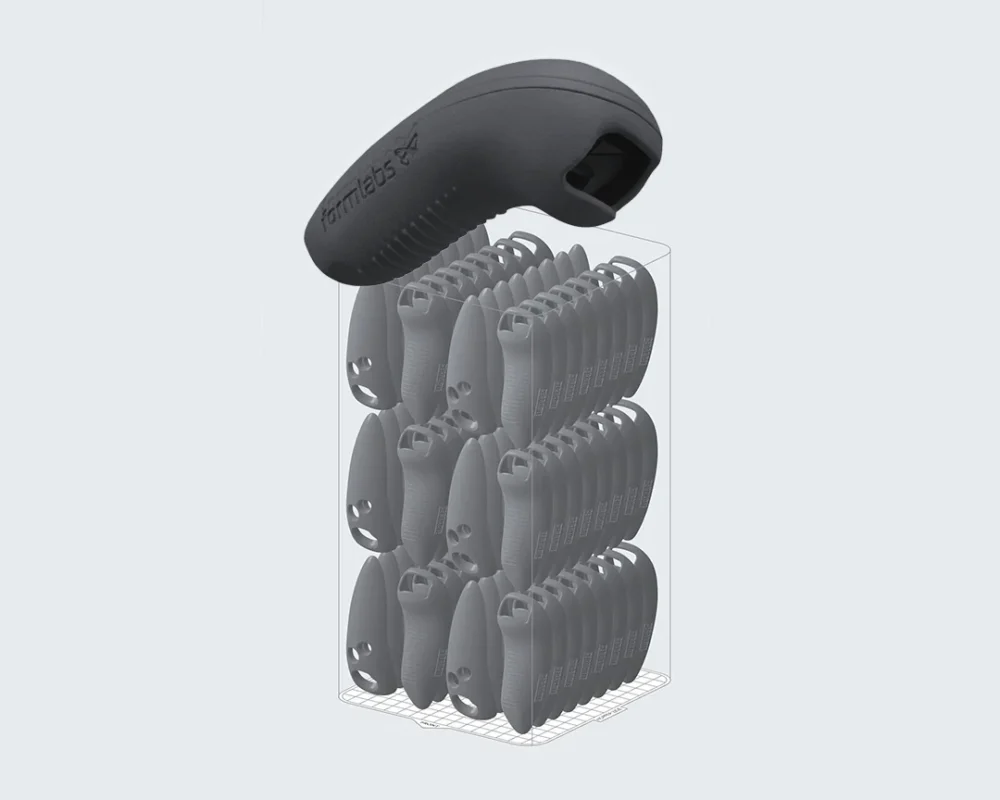
Powder (SLS)
Low-volume batch production of complex functional parts. Since it requires no supports, parts can be “nested” to maximise throughput per build.
Output: 1,120 parts per week
Durability: Very High
Surface finish: High
Post-processing: Minimal
Why Traditional Tooling Fails Modern Manufacturing

The “Design Freeze” Nightmare
Traditional molds take 6–12 weeks to create. In that time, the market moves. Additive manufacturing allows for “Version 2.0” to be printed while “Version 1.0” is still in the field.
Inflexible Iteration
Need a slight change to a connector clip? With a mold, you start over. With additive, you just update the CAD file and hit print.
Sunk Cost Fallacy
A typical injection mold costs $10K upwards sometimes $100,000 or more for complex, multi-cavity molds. Any design flaw found later becomes a catastrophic expense.Why Additive Manufacturing Wins?
If your production run is under 10,000 units, or if your product requires frequent design iterations, additive manufacturing (AM) is no longer just an alternative, it’s the strategic choice.
Beyond cost savings, additive manufacturing unlocks geometries that are physically impossible to achieve with traditional tooling. Whether you are looking to consolidate multiple parts into a single complex assembly, reduce weight through lattice structures, or utilize reverse engineering to recreate legacy components, our 3D technologies bridge the gap between digital design and physical reality.
The Bottom Line: Don’t let expensive tooling dictate your design cycle. Embrace the flexibility of tool-less manufacturing to iterate faster, reduce risk, and scale your production on your own terms.
| Feature | Injection Molding | Additive Manufacturing |
| Upfront Cost | High (Tooling investment) | Near Zero |
| Lead Time | 2–3 Months | 2–5 Days |
| Geometry | Limited by mold release/drafts | Virtually Unlimited |
| Iteration | Expensive & Slow | Instant & Cost-Effective |
| Best For | Mass Production (10k+) | Low-Mid Volume & Complexity |
End-User Quality is No Longer a Myth
New technology allows for 3D prints hard waring durable materials to be used for end-use parts.
Book a Consultation
At Thinglab, we provide a complete, solution-driven ecosystem for your industrial 3D printing needs. From strategic consultation and seamless setup to ongoing maintenance and specialised training. Optimise production processes and stay at the cutting edge of manufacturing technology.
Talk to an expert today, just call 03 7018 2121.
Frequently Asked Questions
It depends on your goal. SLA is for high-detail, smooth surfaces; SLS is for rugged, powder-based production with no supports; FDM is for large, industrial-strength jigs. Thinglab analyzes your CAD files to match you with the right tech.
Throughput varies by technology, part size and geometry. With a high-speed SLS system, a single machine can produce hundreds to thousands of small components per week. We help you calculate your production capacity and ROI to ensure your fleet meets your deadlines.
For production runs ranging from 1,000 to 5,000 units, additive manufacturing often provides a lower total cost of ownership by completely eliminating upfront tooling expenses. While the exact “break-even” point depends on part size and complexity, additive manufacturing consistently outperforms traditional methods in speed-to-market and design freedom, making it the strategic choice for low-to-medium volume production.
We primarily work with STL, OBJ, and STEP files. STEP files are preferred for industrial parts as they maintain high-fidelity geometric data which our software uses to optimise print paths and tolerances.
While all manufacturing methods require some level of finishing, modern Additive Manufacturing (AM) has evolved beyond manual labour. Unlike traditional molding, which often requires manual gate removal, flash trimming, and secondary machining, current industrial AM ecosystems utilize automated post-processing. These integrated systems create a “push-button” workflow that significantly reduces manual touch-time per batch, ensuring consistent results with minimal operator intervention.
Yes. We don’t just ship boxes. Thinglab provides end-to-end integration: on-site installation, material workflow training, and post-processing automation setup to ensure your team is productive from Day 1.
Explore SLS 3D Printers
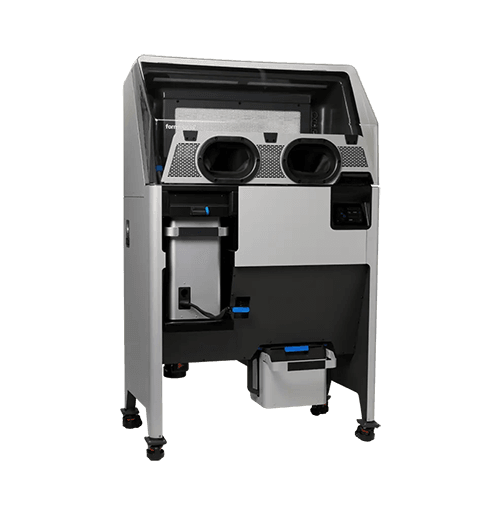
Formlabs Fuse Sift
Maximise your SLS 3D printing workflow with the Formlabs Fuse Sift—an all-in-one powder recovery station.

Formlabs Fuse Blast
Explore the Fuse 1+ 30W 3D high-speed SLS technology. Ideal for engineers in aerospace, automotive, and manufacturing.

Formlabs Fuse 1+ 30W
Explore the Fuse 1+ 30W 3D high-speed SLS technology. Ideal for engineers in aerospace, automotive, and manufacturing.
Explore Resin 3D Printers

Formlabs Form 4BL
The Formlabs Form 4BL is a high-performance printer 3D Printer designed for medical & dental applications, offering exceptional speed and accuracy.

Formlabs Form 4
Formlabs Form 4 3D printer delivers industrial-grade quality products in-house, within hours. Using a variety of high-performance materials.

Formlabs Form 4B
Formlabs Form 4B represents the next evolution in dental and medical stereolithography (SLA) 3D printing technology.

Formlabs Form 4L
Formlabs Form 4L is a blazing fast masked SLA 3D printer with industry-leading materials library and a reliable, accurate print engine.
Book a Consultation
Stop guessing which technology fits your workflow. Book a consultation with Thinglab experts to review your CAD files and build a custom ROI roadmap.